

Many women don’t spend years wondering whether they have ADHD.
Instead, they spend years wondering what is wrong with them.
Why does everyone else seem able to keep up with life so much more easily?
Why does it take so much effort just to stay organized?
Why do simple tasks sometimes feel strangely difficult to start?
Why does it feel like your brain never fully powers down?
For many women, ADHD isn’t something they consider until adulthood. Not because the signs weren’t there earlier, but because ADHD symptoms in women often look very different from the stereotypes most of us grew up with.
Many women are successful, responsible, caring, and highly motivated. They have careers, families, calendars, and to-do lists. From the outside, things may appear relatively put together.
Inside, however, it can feel like they’re juggling dozens of invisible responsibilities while hoping nobody notices how much effort it takes to keep all the balls in the air.
And eventually, many arrive at the same question:
“What if I’m not lazy, disorganized, or bad at being an adult? What if something else is going on?”
Common Signs of ADHD in Women
ADHD symptoms in women can include chronic overwhelm, difficulty staying organized, procrastination, time management struggles, emotional sensitivity, perfectionism, forgetfulness, and feeling like you’re constantly behind no matter how hard you’re trying.
The tricky part is that many of these experiences don’t immediately look like ADHD. They often get labeled as stress, anxiety, personality quirks, or simply “having too much on your plate.”
As a result, many women don’t realize ADHD may be part of the picture until adulthood.

Why ADHD in Women Often Goes Unnoticed
One of the biggest misconceptions about ADHD is that it always looks obvious.
Many women aren’t bouncing off the walls. They’re sitting quietly in meetings while trying to remember three things they forgot to do, mentally rehearsing a conversation they had yesterday, and wondering if they remembered to move the laundry to the dryer.
From the outside, they often look responsible and capable.
Inside, it can feel like they’re carrying dozens of open tabs that never quite close.
Many women become incredibly good at compensating. They create systems, reminders, alarms, lists, backup lists, and sometimes lists reminding them to look at the other lists.
The challenge is that the effort becomes invisible. People see the result, not the amount of energy it took to get there.
It Feels Like Your Brain Never Stops Running
One of the most common descriptions women give after learning about ADHD is:
“I thought everyone felt this way.”
Many women with ADHD experience a constant stream of mental activity.
You may finally sit down to relax only to remember:
- The appointment you need to schedule
- The email you forgot to answer
- The library book still sitting in your trunk
- The fact that you’re almost out of toothpaste
Suddenly your “relaxing evening” has turned into a planning session.
It’s not that you’re trying to think about these things. Your brain simply keeps serving them up. Sometimes at 2:00 AM.
You’re Working Harder Than People Realize
Many women with ADHD aren’t disorganized because they don’t care.
They’re often working extremely hard to stay organized.
You buy planners. Create color-coded calendars. Set reminders. Download productivity apps. Research new organizational systems.
And yet somehow still find yourself searching for your phone while holding it in your hand.
Or opening your laptop only to completely forget why you opened it.
Or rereading the same email three times because your attention keeps drifting halfway through.
This isn’t a lack of intelligence or motivation.
It’s often the invisible work of managing ADHD symptoms in women.
For many people, these challenges can also overlap with anxiety. If you’re curious about how anxiety can affect focus, concentration, and overwhelm, you can learn more on our Anxiety Therapy page.
You Know What To Do, But Starting Feels Impossible
This is one of the most frustrating parts of ADHD.
Many women know exactly what needs to get done.
The issue isn’t knowledge. The issue is getting started.
You might spend days thinking about a project, planning how you’ll tackle it, researching the best approach, and feeling increasingly stressed that you haven’t begun.
Then suddenly you’re deep-cleaning a closet that wasn’t bothering you five minutes ago.
Or researching the best vacuum reviews for an hour. Or reorganizing a drawer you’ve ignored for months. Not because those tasks are more important.
Because your brain found them easier to begin.
This is often related to executive functioning challenges, which play a major role in adult ADHD in women.
Time Has a Way of Slipping Through Your Fingers
Many adults with ADHD experience something called time blindness.
You may:
- Consistently underestimate how long tasks take
- Lose track of time completely
- Feel surprised when an hour has passed
- Run late despite genuinely trying not to
You leave the house convinced you’re right on schedule.
Then discover that somehow getting ready took 47 minutes instead of 20.
At this point, you don’t even know where the extra 27 minutes went.
You were busy the entire time.
Yet somehow time moved differently.
What Women Often Say Before They Realize It’s ADHD
This may be the section people relate to most.
Many women who are eventually diagnosed with ADHD say things like:
- “I thought I was just bad at being an adult.”
- “Everyone else seems to manage life better than I do.”
- “I’m constantly busy but somehow never caught up.”
- “I know exactly what I need to do. I just can’t get myself to start.”
- “I feel exhausted from trying to stay organized.”
- “I thought I was just lazy.”
- “I thought I needed more discipline.”
If any of those statements sound familiar, it doesn’t automatically mean you have ADHD.
But it may be worth exploring further.
Organizations such as CHADD have helped increase awareness about how ADHD presents differently in women:
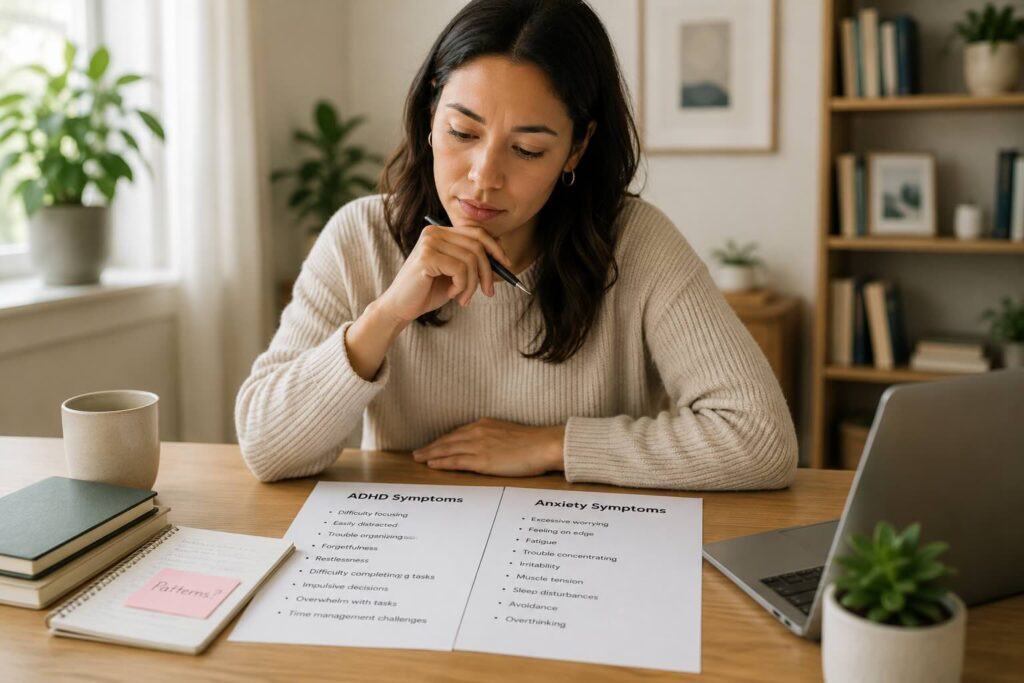
ADHD or Anxiety?
ADHD and anxiety often overlap.
Both can involve:
- Racing thoughts
- Difficulty concentrating
- Feeling overwhelmed
- Restlessness
- Trouble relaxing
This is one reason many women first seek support for anxiety before realizing ADHD may also be contributing.
The difference is that anxiety is often driven by worry and fear, while ADHD is typically related to difficulties with attention regulation, executive functioning, organization, and follow-through.
Many people experience both.
If you’re interested in learning more about anxiety treatment, visit our anxiety page.
If you’re specifically exploring ADHD, our ADHD Therapy page may also be helpful.
When To Consider Support
You don’t have to wait until things are falling apart to seek support.
Many women reach out because they’re tired of feeling like they’re working harder than everyone else just to keep up.
Others are looking for answers after years of wondering why certain challenges never seemed to improve despite their best efforts.
Therapy can help you better understand your patterns, develop practical strategies, and reduce the self-criticism that often develops when ADHD goes unrecognized for years.
At Coastal Therapy & Wellness, we work with adults navigating ADHD, anxiety, stress, and related concerns.
You can learn more about our Adult Therapy services here.

Frequently Asked Questions
Can ADHD develop later in life?
ADHD is considered a neurodevelopmental condition, meaning symptoms typically begin earlier in life. However, many women don’t recognize the signs until adulthood.
Why is ADHD often missed in women?
ADHD symptoms in women are often more internalized and can look different from common stereotypes, making them easier to overlook.
Is ADHD different in women than men?
The core condition is the same, but symptoms may present differently. Women are often more likely to experience overwhelm, inattentiveness, emotional sensitivity, and masking behaviors.
Can ADHD look like anxiety?
Yes. ADHD and anxiety share several overlapping symptoms, and many people experience both.
Can therapy help adults with ADHD?
Therapy can help individuals understand their symptoms, improve organization and coping strategies, reduce self-criticism, and address related concerns such as anxiety and stress.
Final Thoughts
Many women spend years believing they’re disorganized, forgetful, bad at time management, or simply not trying hard enough.
Sometimes there’s another explanation.
Understanding ADHD doesn’t change who you are. It simply provides a different lens through which to understand experiences that may have felt confusing for years.
If parts of this article felt surprisingly familiar, it may be worth exploring further.
At Coastal Therapy & Wellness, we offer in-person therapy in Seal Beach and virtual therapy throughout California. Our therapists support adults navigating ADHD, anxiety, overwhelm, stress, and related challenges while helping them develop strategies that actually fit the way their brain works.
Learn more about ADHD Therapy here.
If you’re ready to feel a little more like yourself again, we’re here to help.
Reach out through our contact form to get started or call us directly if that feels easier.
Contact number: (562) 568-7900
Email Address: info@coastaltherapyandwellness.com